




1240+ Reviews
Time Tracking Software

Time tracking software that gives finance what spreadsheets can't

ClickTime tracks time and maps every hour to GL codes, cost centers, and billing categories at entry—so finance gets clean, verified data without the cleanup.

Get a demo
Trusted by thousands of companies of all sizes

Labor cost visibility starts with better time data.

Most time tracking software captures hours. That's the bare minimum. The real problem is what happens next—finance exports the data, discovers it's uncategorized, and spends days reconciling entries against cost centers, GL codes, and billing structures. 40% of finance leaders don't trust their own labor cost data, and this is why.

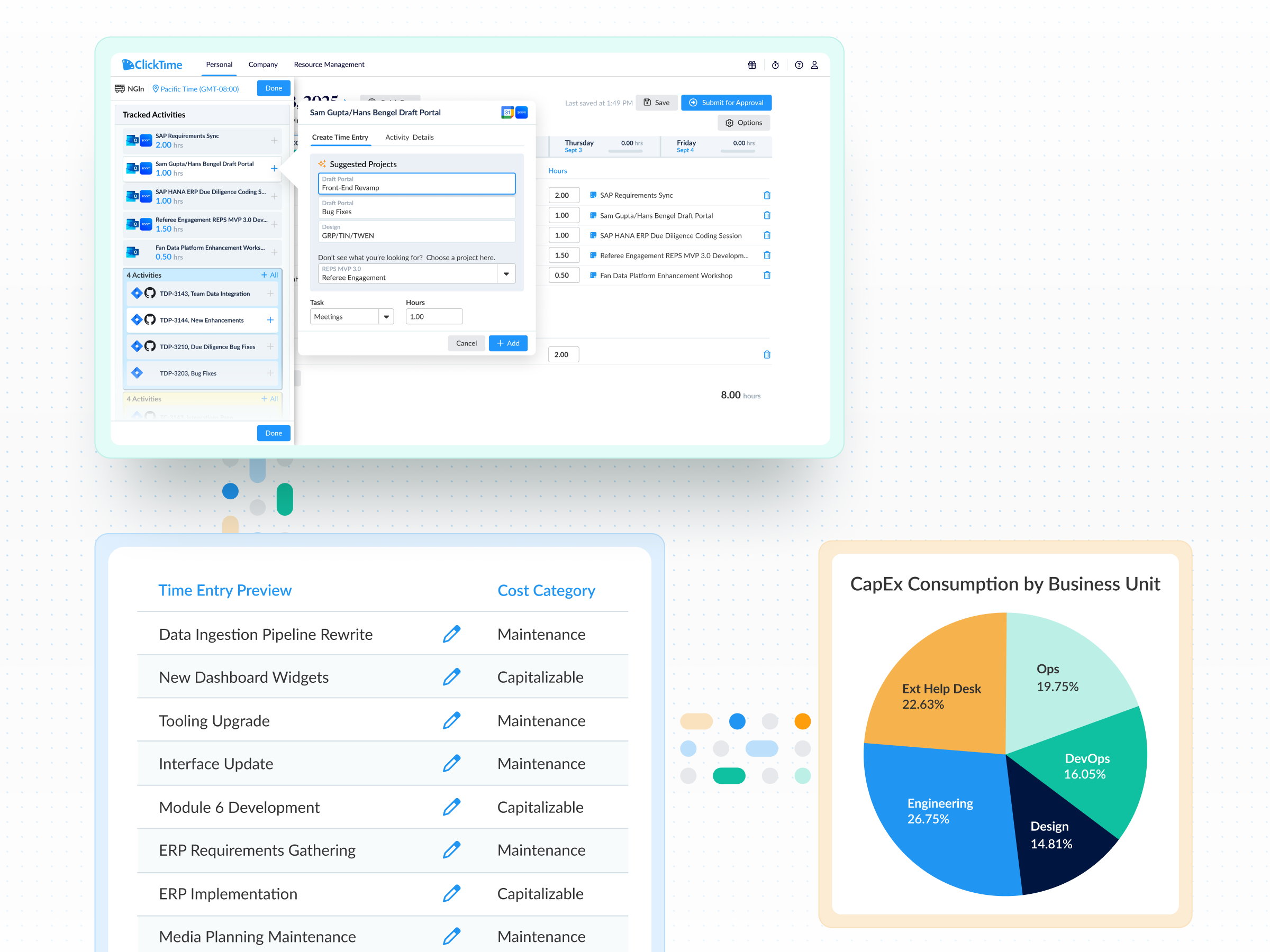
ClickTime is time tracking software built for a different outcome. Every hour is mapped to the categories finance actually uses—project, client, cost center, CapEx vs. OpEx, R&D-eligible work—at the moment it's captured. With Smart Match, ClickTime pulls employees' existing digital footprint from calendars, Jira, and other work tools, then matches that activity to your finance-defined categories. The result: labor cost visibility that's ready for reporting, billing, and audits the moment it arrives.

Finance-ready data at entry

Every hour is categorized to match the structure you need—no reconciliation required

Audit-ready records

Built-in approvals and complete audit trails satisfy auditors and protect compliance

Automatically captured, without surveilance

Your team's footprints across their work tools—no double entry, no miscoding

Capture time where work happens—already categorized.

Automated time tracking that doesn't interrupt your team's workflow or crawl their personal activities. ClickTime is the only time tracking software that translates directly into data ready for finance and ops, without burdening employees.

View all features
 

CapEx and OpEx labor tracking

Maximize tax benefits with automated CapEx/OpEx labor categorization


Enterprise time tracking

Enterprise time tracking that turns work hours into finance-ready data across teams, departments, and locations—with the controls large organizations require.

Learn more
 

Resource capacity planning

Plan capacity strategically to avoid resource scrambles

Learn more
 

Integrations and data exporting

Power your ERP, HRIS, and data warehousing with seamlessly integrated, verified labor data


Mobile timesheets

Log hours, capture expenses, and submit timesheets from any device. ClickTime Mobile syncs every entry to your labor cost reporting in real time.

Learn more
 

DCAA compliant timesheets

Protect government contracts with DCAA-compliant labor records

Learn more
 

Single Sign-On (SSO)

Ensure secure, compliant access and streamline IT management with enterprise-grade Single Sign-On (SSO)

Learn more
 

Time entry options

Configure time tracking to deliver the cost data your business needs

Learn more
 

Time sheet approvals

Ensure audit-ready financial records with robust, built-in timesheet approval workflows

Learn more
 

Connected Calendar

Google Calendar and Outlook events become timesheet entries with one click. Meetings, client calls, and focus time are captured accurately—not reconstructed from memory at month-end.


Jira integration

Developer activity translates directly into finance-ready labor cost data. Admins map Jira projects to cost centers, GL codes, and CapEx/R&D categories—engineers just work in Jira.


Org-wide visibility

However your teams track time—Jira, calendar, ClickTime’s native online timesheets and mobile—it all flows into one system. No gaps, no silos, no spreadsheet reconciliation.

"ClickTime is a game changer. We're able to get the answers we need, and make faster, data-driven decisions around budgeting and managing our projects. ClickTime fundamentally improved how we manage our finances, staff projects, and plan our budgets."
Van Chang
Director of Finance at COPE Health Solutions
Protect margins on client work

Track time without adding work to anyone's day

  • Smart Match reads employees' digital footprint—calendar events, Jira tickets, project activity—and maps it to custom finance categories like GL codes, CapEx, OpEx, and R&D
  • Optional AI matching suggests the right cost buckets based on activity patterns, so employees confirm rather than code from scratch
  • Reminders keep timesheet submissions on track, and managers see who's behind before the close
INTERNAL PROJECTS

See where hours go—and whether they're earning a return

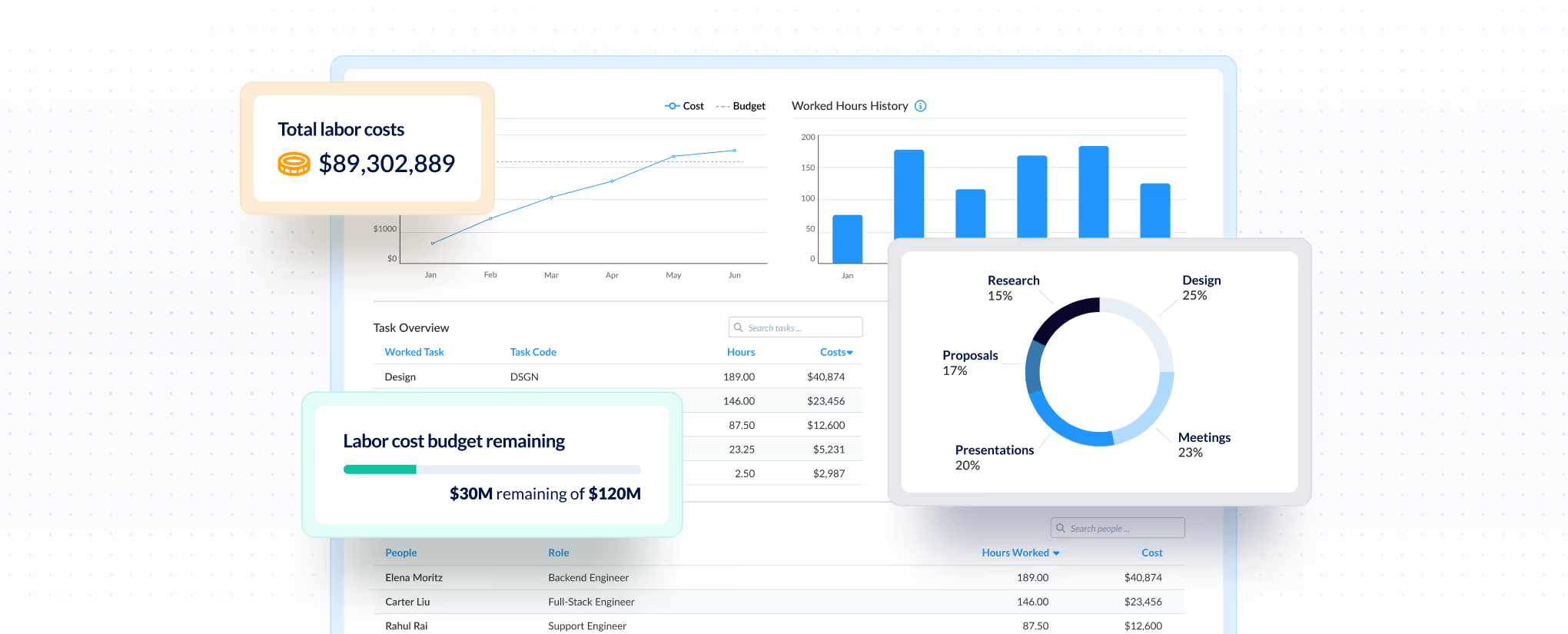
Over 31% of organizations still rely on spreadsheets for labor cost tracking, which means they can't answer basic questions: are people spending too much time in meetings? Is that project earning an ROI? ClickTime's reporting breaks down time by the categories that matter to finance—so leaders spot unproductive patterns, identify projects that aren't covering their costs, and reallocate before budgets overrun.

Grant compliance for non-profits

Verified hours with a complete audit trail

  • Multi-level approval workflows match your org structure—every timesheet is reviewed before it hits your books
  • Full audit trail on every entry, edit, and approval protects you when auditors or clients ask questions
  • Lock periods prevent retroactive changes after close, so your labor cost records stay defensible
Integrations

Integrations that reduce double entry and improve data accuracy

View all integrations

Everyone has AI. Most people don't have the accurate time data to feed it. ClickTime is your system of record for labor cost data—connecting the tools your team already uses to create accurate, approved data ready for your finance systems.

Smart Match
Smart Match
Smart Match
Smart Match
Smart Match
Smart Match
Integrations

Integrations that reduce double entry and improve data accuracy

View all integrations

Everyone has AI. Most people don't have the accurate time data to feed it. ClickTime is your system of record for labor cost data—connecting the tools your team already uses to create accurate, approved data ready for your finance systems.

Smart Match
Smart Match
Smart Match
Smart Match
Smart Match
Smart Match
FAQs

Questions we get often about ClickTime

From basic time tracking to complex compliance needs

See all FAQs
How is ClickTime different from basic time tracking tools?

Most tools give you a log of hours. ClickTime structures every entry by project, client, cost center, and work type—so you get finance-ready labor cost data, not a spreadsheet to clean up.

Will our team actually use time tracking software?

Yes. ClickTime offers multiple entry methods (automation through calendar and Jira integrations with Smart Match, and more on the way, ClickTime’s mobile app and web time tracker), pre-filled categories, and reminders. The whole ClickTime team uses the software we build everyday, so we make sure it’s simple and functional.

How long does implementation take?

Most teams are up and running within a few days, but some more complex organizations might take a few weeks. Our implementation team helps configure your cost structure, approval workflows, and integrations.

Does ClickTime integrate with our ERP/accounting system?

Yes. We integrate with leading systems including NetSuite, QuickBooks, Sage Intacct, and more. Data exports map directly to your chart of accounts.

Can ClickTime integrate into my existing billing or accounting system?
Exporting data & integration

Yes! ClickTime integrates with many accounting systems. See the full list on our Integrations page.

Can we import our data into ClickTime, for example, our employees and previous time data?
Pricing

We are able to import timesheet data on an as-quoted basis. Please contact our Sales Team for further information.

How do I demo ClickTime?

Glad you asked! Simply fill out our Demo Request Form, and we'll set up a time to walk you through ClickTime.

What is the best way to track your time for labor cost visibility?

The most effective approach captures time at the moment work happens, categorized by project, client, and cost type. ClickTime structures every entry with the financial context finance teams need—eliminating the manual cleanup that makes most time data unreliable.

How does time tracking improve budget accuracy?

When time is captured with proper cost categorization at entry, finance teams can compare actual labor spend against budgets in real time. This visibility helps catch overruns early and provides the verified data needed for accurate forecasting and resource planning.

What features should I look for in time tracking software?

Look for software that captures time with financial context (project, client, cost center), includes approval workflows for data verification, maintains a complete audit trail, and integrates with tools your team already uses. These features ensure the data is usable for billing, budgeting, and compliance without additional cleanup.

Why is time tracking important for audits?

Audit-ready time tracking provides documented evidence of labor costs tied to specific projects and cost categories. With built-in approval workflows and complete audit trails, organizations can demonstrate compliance and respond to auditor questions with verified records rather than reconstructed estimates.

What is time tracking software and how does it work?

Time tracking software captures how employees spend their work hours across projects, clients, and tasks. Most tools log hours in a basic timesheet format, but ClickTime goes further—every hour is categorized by GL code, cost center, billing type, and work classification (like CapEx vs. OpEx) at the moment of entry. This means finance and operations leaders get structured, finance-ready labor cost data rather than a raw log that requires manual cleanup.

Is time tracking software better than spreadsheets?

Over 31% of organizations still use spreadsheets for labor cost tracking, and the risks are significant—version control errors, missing entries, and no audit trail. Dedicated time tracking software like ClickTime captures hours at the source, ties them to pre-defined finance categories, and creates approval workflows with a complete audit trail. The result is verified data that's ready for reporting, billing, and compliance without reconciliation.

What's the difference between manual and automated time tracking?

Manual time tracking requires employees to recall and enter hours after the fact, which introduces errors and missing data. ClickTime's Smart Match feature takes a different approach—it reads employees' existing digital footprint from tools like Jira, Google Calendar, and Outlook, then matches that activity to finance-defined categories. Employees review and confirm rather than code from scratch, which improves accuracy and completion rates.

Who should use time tracking software?

Any organization where labor is a significant expense benefits from time tracking—but the real value depends on what happens with the data. ClickTime is built for finance and operations leaders who need labor cost data for budgeting, billing, compliance, and strategic planning. Professional services firms, nonprofits managing grants, and companies capitalizing software development costs see the highest impact because accurate time data directly affects their financial reporting.

Stop losing visibility into your largest expense

Book a demo
Ask a question